Rupee, Rupiah and Other EM Currencies Hit Record Lows
Several emerging-market currencies are trading at or near record lows against the US dollar, led by the Indian rupee and Indonesian rupiah. For travellers, expats and businesses, the moves are a reminder to compare rates carefully before sending or exchanging money.
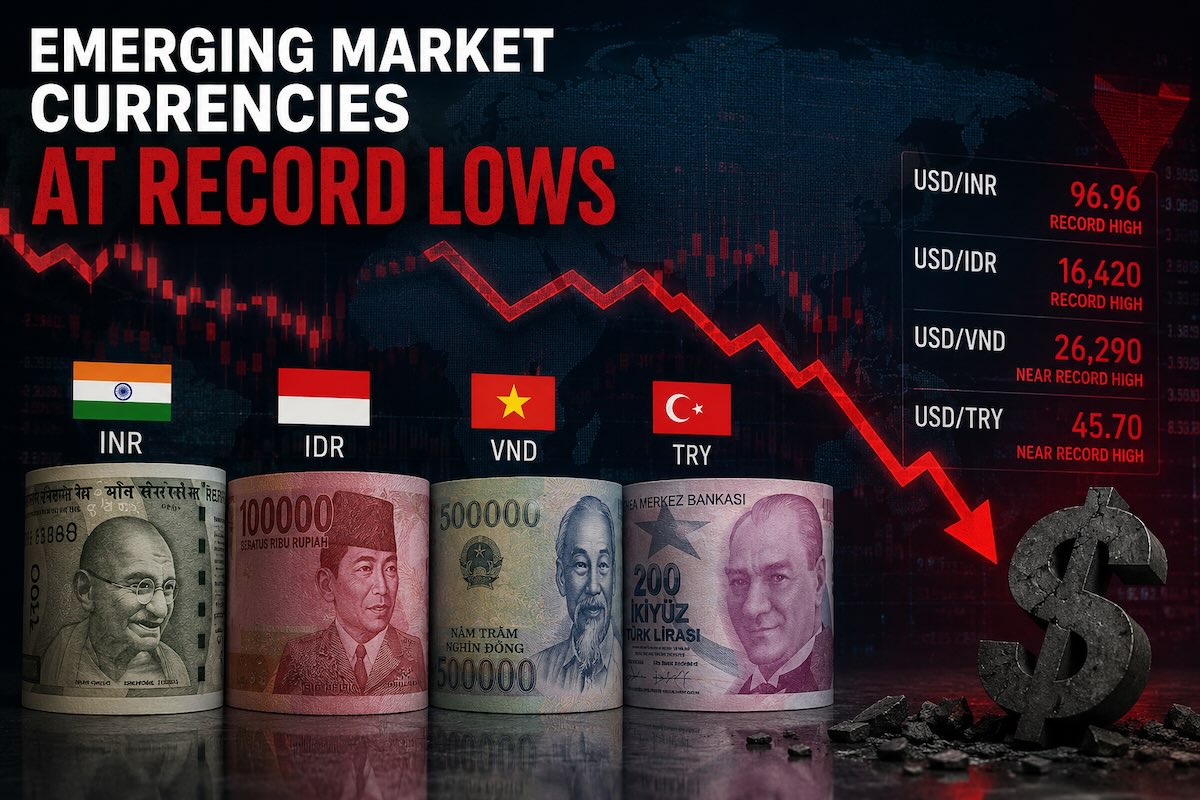
Several emerging-market currencies are trading at or near record lows against the US dollar as higher energy prices, capital outflows and renewed dollar strength pressure economies that rely heavily on imported fuel or foreign capital.
The Indian rupee (INR) has been one of the most closely watched moves, falling to fresh record lows before recovering slightly after support measures from the Reserve Bank of India. The Indonesian rupiah (IDR) has also come under heavy pressure, prompting Bank Indonesia and the finance ministry to take steps aimed at attracting portfolio inflows.
Vietnam’s dong (VND) and Turkey’s lira (TRY) are also trading around historically weak levels, highlighting a broader stress point across emerging markets: when the US dollar strengthens and oil prices rise, countries with external funding needs can see their currencies weaken quickly.
Why emerging-market currencies are under pressure
The common drivers are:
- Stronger US dollar: Better US economic data and higher Treasury yields tend to pull capital toward dollar assets.
- Higher energy costs: India, Turkey and many Asian economies are large energy importers, so higher oil and gas prices can worsen trade balances.
- Portfolio outflows: Foreign investors have been reducing exposure to some emerging-market bonds and equities.
- Central bank pressure: Policymakers face a difficult balance between supporting growth, controlling inflation and defending currencies.
- Geopolitical risk: Middle East tensions have added volatility to oil markets and global risk sentiment.
Indian rupee: record lows despite RBI support
The Indian rupee has been under sustained pressure, with USD/INR moving to record highs in recent weeks. India is particularly exposed to higher crude prices because it imports much of its energy, which can widen the current account deficit and add to inflation pressure.
For Indian students, migrants and families receiving or sending money overseas, a weaker INR means foreign currency costs rise quickly. Tuition fees, rent, travel and overseas living expenses become more expensive when priced in USD, AUD, GBP or EUR.
BER rate links: USD to INR, AUD to INR, GBP to INR
Indonesian rupiah: policy support after sharp falls
The Indonesian rupiah has also weakened sharply, with authorities moving to support local assets and attract capital inflows. Indonesia’s currency pressure reflects a mix of dollar strength, investor concerns over fiscal policy, fuel subsidy costs and foreign outflows from local markets.
For Australian travellers heading to Bali, a weaker IDR can make local spending look cheaper in AUD terms, but travel-money margins can still vary widely between banks, airport kiosks and specialist providers.
BER rate links: AUD to IDR, USD to IDR
Vietnamese dong: trade deficit adds pressure
Vietnam’s dong is also trading around fresh weak levels against the US dollar. Vietnam remains one of Asia’s strongest growth stories, but a wider trade deficit and rising imported fuel costs have added pressure to the currency.
For businesses importing from Vietnam or paying suppliers in VND, currency weakness can reduce local-currency costs. However, the benefit depends heavily on contract terms, hedging and whether prices are ultimately set in USD.
BER rate links: USD to VND, AUD to VND
Turkish lira: still near record lows
The Turkish lira remains one of the world’s most persistently weak major emerging-market currencies. Inflation remains high, political risk has weighed on investor confidence, and the currency continues to trade near record lows against the US dollar.
For travellers, Turkey may appear cheaper in foreign-currency terms, but high domestic inflation can quickly offset the benefit of a weaker exchange rate.
BER rate links: USD to TRY, EUR to TRY, GBP to TRY
What it means for travellers and money transfers
A record-low currency does not automatically mean a good deal. The actual rate you receive depends on the provider margin, transfer fee and timing.
Tip: When a currency is volatile, compare both the exchange rate and total fees. A provider advertising “no fee” may still include a wider margin in the exchange rate.
For travellers, weak local currencies can make hotels, meals and transport cheaper, but airport exchange desks and bank travel cards often apply less competitive rates.
For expats and families sending money home, volatility can create both risk and opportunity. Sending in stages or setting a rate alert may help reduce timing risk.
For businesses, currency weakness can affect import costs, supplier payments and overseas invoices. Larger transfers should be compared carefully, especially where the rate margin can make a meaningful difference.
Outlook: more volatility likely
Emerging-market currencies are likely to remain sensitive to oil prices, US interest-rate expectations and capital flows. If the US dollar stays strong or energy prices rise further, currencies such as INR, IDR, VND and TRY may remain under pressure.
However, central bank intervention, higher local yields or renewed foreign inflows could help stabilise the weakest currencies. For consumers and businesses, the practical takeaway is simple: check live exchange rates, compare provider margins and avoid assuming your bank is offering the best deal.
Compare live rates: BestExchangeRates.com Compare Rate Calculator
Disclaimer: Please note any provider recommendations, currency forecasts or any opinions of our authors should not be taken as a reference to buy or sell any financial product.