US Dollar Guide (USD): Rates, Travel & Money Transfers
Understand how the US dollar works, what moves USD exchange rates and how travellers, expats and businesses can compare conversion and transfer costs.
Currency guide · Reviewed July 2026
The US dollar at a glance
The US dollar (USD) is the currency of the United States and the leading international currency across foreign-exchange trading, official reserves, funding and cross-border payments. Its global role means a broad move in USD can affect travel budgets, business costs and financial conditions far beyond the United States.
The practical takeaway
There is no single dollar exchange rate. Check the currency pair that matches your payment and compare the final converted amount after the provider's customer rate, transfer fee and possible bank charges.
Quick facts
What to know about USD
01
Code and symbol
The ISO currency code is USD. Use US$ when the dollar symbol could be confused with Australian, Canadian or other dollar currencies.
02
Central bank
The Federal Reserve System is the US central bank and conducts monetary policy with a dual mandate from Congress.
03
Seven current notes
The Federal Reserve currently issues $1, $2, $5, $10, $20, $50 and $100 notes.
04
Floating currency
USD floats against other major currencies. Its price changes continuously when global FX markets are open.
05
Largest reserve share
The IMF reported that USD accounted for 57.13% of allocated global foreign-exchange reserves in the first quarter of 2026.
06
Central to FX trading
The BIS reported that USD was on one side of 89.2% of global foreign-exchange trades in its April 2025 survey.
Strong or weak?
Measure the dollar in the right way
The dollar can rise against one currency while falling against another. Travellers, businesses and recipients should start with their actual pair rather than a broad headline about USD strength.
Broad market indicator
US Dollar Index (DXY)
DXY measures USD against a fixed basket of the euro, Japanese yen, British pound, Canadian dollar, Swedish krona and Swiss franc. It began at 100 in 1973.
Important limitation
The basket is not global trade
The euro has the largest DXY weight, while currencies of major US trading partners such as China and Mexico are absent. Use DXY as one indicator, not a complete picture.
Read the US Dollar Index guide for the basket weights, history and limitations.
Live cross-currency view
Compare USD across more currencies
The module below shows recent performance against a wider range of currencies. Open an individual pair for its current rate, chart and provider comparisons.
| Pair | Why it is watched |
|---|---|
| EUR/USD | A major global pair shaped by Federal Reserve and European Central Bank expectations. |
| GBP/USD | Responds to relative US and UK inflation, growth and interest-rate expectations. |
| USD/JPY | Often sensitive to the large interest-rate difference between the United States and Japan. |
| USD/CAD | Important for North American trade and influenced by relative growth, rates and commodity conditions. |
| AUD/USD | Often responds to global risk sentiment, commodity demand and US–Australian rate expectations. |
Exchange-rate drivers
What moves the US dollar?
Markets price expectations, so USD can move before a Federal Reserve decision or economic release and can react differently from a simple “good data means stronger dollar” rule.
Fed
Interest-rate expectations
Inflation, employment and growth data can shift expectations for Federal Reserve policy and the relative return on dollar assets.
Risk
Demand for liquidity
During financial stress, demand for dollar cash, US Treasuries and dollar funding can increase—even when the uncertainty begins in the United States.
Growth
Relative economic performance
Differences between US growth and conditions elsewhere can influence capital flows and exchange-rate expectations.
Fiscal
Borrowing and policy
Government borrowing, fiscal policy, tariffs and confidence in US institutions can affect yields, inflation expectations and the dollar in different ways.
Trade
Global invoicing
Many commodities, contracts and debts are priced or settled in dollars, creating USD demand outside the United States.
Other central banks
Relative policy matters
USD pairs also respond to decisions and expectations for the ECB, Bank of Japan, Bank of England and other central banks.
Dollarisation and pegs
Which countries use or track the US dollar?
Adopting USD and pegging a separate currency to USD are different arrangements. They do not remove retail conversion fees.
USD as currency or legal tender
Countries using US dollars
Sovereign examples include Ecuador, El Salvador, Panama, Timor-Leste, the Federated States of Micronesia, the Marshall Islands and Palau.
The arrangements differ. Panama issues balboa coins alongside US notes, while some Pacific countries issue local coins. Zimbabwe has used a multi-currency framework rather than USD as its only national currency.
Separate currency linked to USD
Examples of dollar pegs
The Hong Kong dollar, Saudi riyal, United Arab Emirates dirham, Bahraini dinar, Omani rial and Belize dollar are managed against USD at fixed rates or within formal arrangements.
Not every stable-looking rate is a pure dollar peg. Kuwait, for example, manages its dinar against an undisclosed currency basket.
Informal dollar acceptance in tourist areas is not the same as legal tender. The merchant's conversion rate may be poor and change may be returned in local currency.
Travel decision panel
Cash or card in the United States?
Cards are widely accepted, but cash remains useful for tips, small merchants and backup. Sales tax is commonly added at checkout, so the amount charged can be higher than the shelf price.
Card
Check issuer charges
Review the card's foreign-transaction fee, exchange-rate method, ATM fee and withdrawal limit before departure.
Cash
Carry a practical backup
Compare cash exchange margins and commission. Avoid buying substantially more USD than you expect to spend because converting leftovers creates another cost.
ATM
Read the screen
An ATM operator can add its own fee. Your bank or card provider may charge separately for the withdrawal and currency conversion.
At the terminal
Keep control of the conversion
- Choose USD when offered a currency choice. Paying in your home currency uses dynamic currency conversion set by the merchant or ATM provider.
- Check the displayed exchange rate. Convenience does not mean the conversion is competitive.
- Remember your card's own fee. Choosing USD avoids the terminal's conversion, but your issuer can still charge for overseas use.
- Check ATM operator fees. These can apply in addition to your card provider's charges.
- Keep more than one payment method. Cards can be declined, terminals can fail and some merchants prefer cash.
International payments
Sending money to or from the United States
USD transfers are common for migration, pensions, property, tuition, investments, supplier invoices and overseas payroll. The best route depends on the source currency, destination, amount, funding method and required delivery time.
01
Match the quote
Use the same sending amount, currencies, payment method, destination and quote time for every provider.
02
Check the final USD amount
Compare the recipient amount after the customer exchange rate and every disclosed provider fee.
03
Ask about bank deductions
International USD payments can involve correspondent or recipient-bank fees. Check whether the recipient amount is guaranteed or estimated.
Live comparison
Compare current USD conversion costs
The mid-market rate is a reference. Retail quotes can include an exchange-rate margin plus transfer, card, intermediary or receiving fees. Confirm the provider's final screen before paying.
Sponsored provider option
OFX international transfers
OFX is one provider available in BER's comparison. Its customer exchange rate includes a margin and product terms vary by market. Compare its final recipient amount and delivery estimate with other eligible providers.
OFX at a glance:
OFX has a 20-year history and is one of the largest foreign exchange specialists in the world. It offers a complete foreign exchange solution, including discounted money transfers, currency hedging tools, recurring transfers, a multi-currency account for online sellers and much more.
OFX grew from the idea that there had to be a better, fairer way to move money around the world. That was over 20 years ago, and since then over 1 million customers have trusted OFX with transfers in 50+ currencies to over 170 countries.
OFX don’t just offer great rates, they believe real help from real people counts. That’s why their clients get the best of both worlds – a seamless digital platform, combined with 24/7 phone access to currency experts.
When it comes to moving money, peace of mind is important. OFX is monitored by over 50 regulators globally and work within a network of carefully selected banking partners. So whether you are sending money to friends and family abroad, or doing business across borders, OFX can get your money where it needs to go. Fast, simple, secure.
Learn more about OFX
Using OFX for money transfers offers the benefit of lower fees and competitive exchange rates compared to traditional banks, making international transactions more cost-effective.
Additionally, OFX provides 24/7 customer support, a range of transfer options including spot and forward contracts, and a user-friendly online platform, enhancing convenience and flexibility for global financial transactions.
What Savings Can I Expect with OFX?
OFX offers exchange rates that beat the banks, and are close or equal to the rates offered by the industry’s lowest-cost services.
When you register via our OFX 0.5% exclusive offer for BER users the cost of sending, for example, 5,000 US dollars to Australia equates to 0.5 percent of the transferred amount, or roughly US$25. You’d pay the same 0.5 percent for the same amount to be sent to Europe and around 1 percent if sending to India. This compares with 4–7 percent with the banks.
For other currency routes we looked at (routes involving AUD, INR, GBP, EUR, SGD and USD), the average cost of an international payment with OFX was 0.6 percent of the transferred amount. This is exceptional if compared with banks but can be a little more expensive than what is charged by the industry’s lowest-cost services, although such services do not offer the same benefits and customer service as OFX.
Notes and coins
What does US currency look like?
Current Federal Reserve note denominations are $1, $2, $5, $10, $20, $50 and $100. Older designs can remain legal tender, so a genuine note does not become worthless simply because a newer design is in circulation.
Banknotes
Similar size, different denominations
US notes are similar in size and predominantly green, although newer designs use additional colours and security features. Check the printed denomination carefully.
Common coins
Cents and dollar coins
Common denominations are 1¢, 5¢, 10¢ and 25¢. Half-dollar and $1 coins are valid but encountered less often in everyday change.
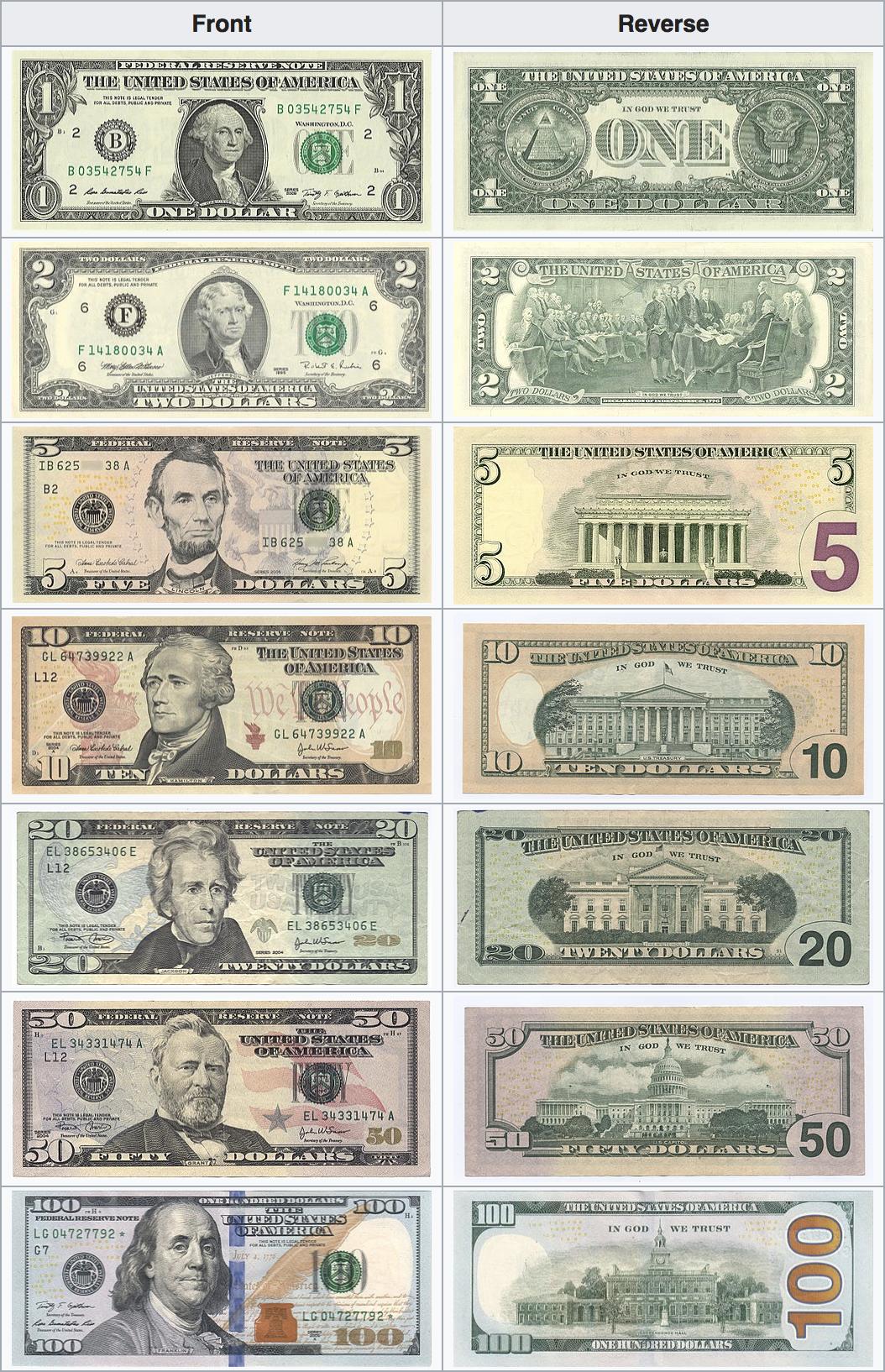
US dollar banknotes, front and reverse designs.
Bottom line
Use the pair, price and deadline that matter to you
USD is globally important, but that does not make its next move predictable. For a real payment, focus on the relevant currency pair, final converted amount, possible bank deductions and delivery timing. For a large future obligation, manage the budget and timing risk rather than relying on one market forecast.
Sources and methodology
- IMF COFER data brief, first quarter 2026
- Federal Reserve: The International Role of the U.S. Dollar—2025 Edition
- Federal Reserve: currency denominations
- BIS 2025 Triennial Central Bank Survey
Factual review completed 28 July 2026. Live rates, performance modules and provider comparisons update independently of the article text.
Disclaimer: Please note any provider recommendations, currency forecasts or any opinions of our authors should not be taken as a reference to buy or sell any financial product.