South Korean Won Rebounds Nearly 8% Against Dollar in July
The won reversed much of its first-half weakness in July, changing the conversion backdrop for South Korea travel, USD transfers and overseas payments.
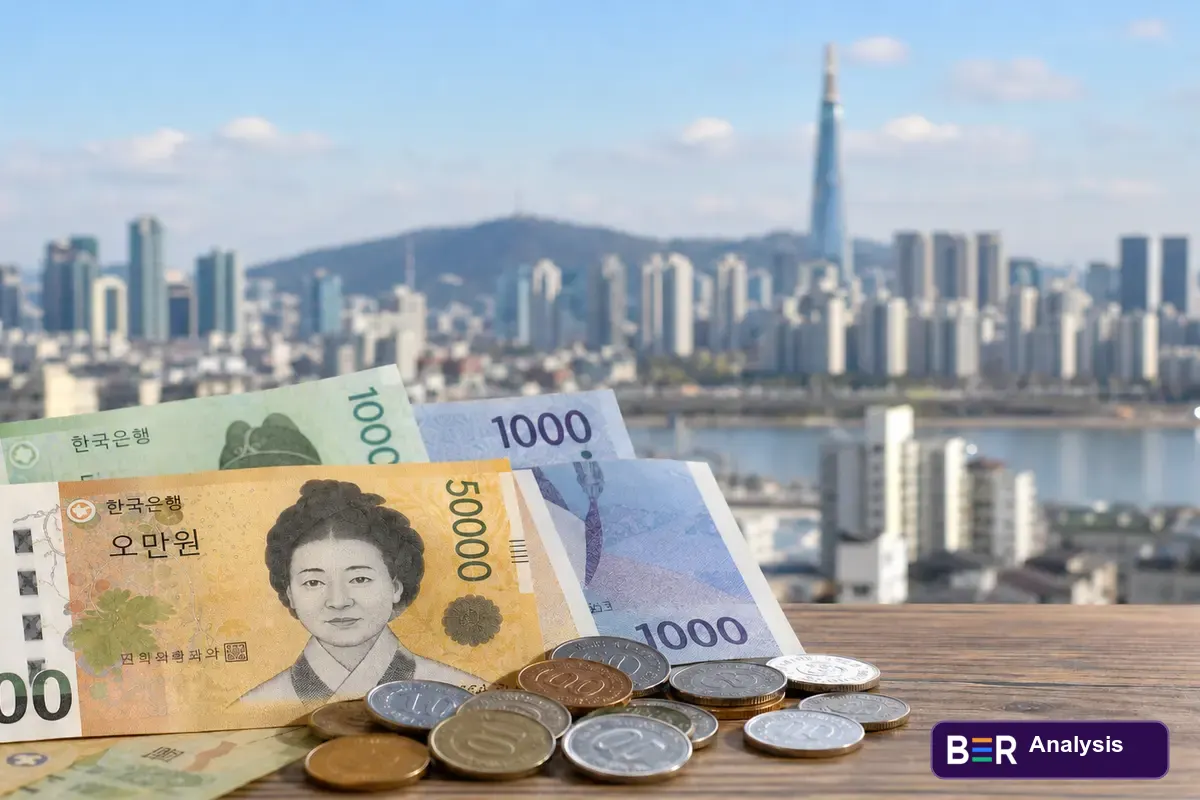
KRW reversal · 3 August 2026
The Won's July Rebound Changes the Conversion Picture
The South Korean won strengthened by nearly 8% against the US dollar during July, according to the Financial Times, reversing much of its first-half decline even as Korean technology shares experienced a sharp sell-off.
BER recorded USD/KRW near 1,430 on 3 August, compared with 1,544.5 when Korean markets opened on 3 July. Put another way, one US dollar bought about 115 fewer won at the early-August market level than at that early-July observation. Customer rates will differ because providers can add an exchange-rate margin and fees.
Story in brief
The July recovery materially changed the won backdrop for travellers and international payments. US-dollar holders receive fewer won than they did near the early-July lows, while won holders need fewer KRW to buy a dollar. The move does not guarantee further gains, and customers should check the pair and final quote matching their transaction.
From first-half weakness to July strength
How the South Korean Won Reversed Course
The won entered July under pressure. It had lost 5.92% against the US dollar by 3 July compared with the end of 2025, according to Yonhap Infomax data reported by Yonhap News Agency. The first-half average was approximately 1,484.56 won per dollar, the second-highest first-half average on record after 1998.
The direction began to change early in July. Yonhap reported the won at 1,498.5 per dollar on 8 July, its strongest level in almost two months, after overseas investors turned net buyers of Korean shares. Analysts cited by Yonhap said foreign-exchange forwards linked to SK hynix's planned US listing also appeared to support the currency.
On 16 July, the Bank of Korea described USD/KRW moving from the mid-1,500s into the upper-1,400s as foreign-exchange supply-and-demand conditions improved. The Financial Times subsequently reported that the won had gained nearly 8% against the dollar over July despite the technology-stock sell-off.
A falling USD/KRW rate means the won is strengthening against the dollar. The same move should not be applied automatically to AUD/KRW, GBP/KRW or EUR/KRW because each cross also reflects changes in the other currency.
The chart provides live historical USD/KRW context and will continue to update after the article's 3 August observation. It is not a customer quote or proof of why the won moved.
Several forces, no single proven cause
Why KRW Strengthened Despite the Tech Sell-Off
The divergence between a stronger won and weaker technology shares shows why equity-market direction alone is not a reliable guide to KRW. Several developments coincided with the rebound, but their individual contribution cannot be measured precisely from the available reports.
01
Changing capital flows
Yonhap reported overseas investors returning as net buyers on 8 July and analysts pointing to foreign-exchange forwards connected with the planned SK hynix US listing. The Bank of Korea later said overall FX supply-and-demand conditions had improved.
02
A Bank of Korea rate rise
The Bank of Korea unanimously raised its Base Rate from 2.50% to 2.75% on 16 July, its first increase since January 2023. Higher rates can support a currency, but the relationship is not automatic and the decision was widely anticipated.
03
Strong exports and reform
The central bank said exports and investment had strengthened, led by semiconductors. Seoul is also making KRW trading and settlement more accessible to overseas institutions, which may influence liquidity and capital flows over time.
The won remains sensitive to US interest-rate expectations, energy prices, trade flows, overseas investment by Korean residents and global risk sentiment. Those forces can reinforce or reverse one another, so July's gain should not be presented as a settled trend.
Travel and transfer consequences
What a Stronger Won Means for Currency Customers
The practical result depends on which currency the customer holds and which direction they are converting.
Visitors holding US dollars
USD to KRW
When USD/KRW falls, a US-dollar traveller or transfer sender receives fewer won before fees. At 1,430 won per dollar, US$1,000 is equivalent to about 1.43 million won at the market rate, compared with roughly 1.54 million won at 1,544.5.
Live rates
Korean residents paying overseas
KRW to USD
A stronger won improves the wholesale conversion into dollars. That can reduce the KRW cost of dollar-denominated travel, tuition, subscriptions or supplier invoices, although the actual result still depends on the provider's rate and charges.
Related comparison
Travellers from Australia, Britain or Europe should not infer their result from USD/KRW alone. They should follow the actual pair used for the transaction, such as AUD to KRW, because their home currency may have moved against both the US dollar and the won.
When a Korean card terminal or ATM offers a choice, paying in won generally leaves the conversion to the card network and issuer. Choosing a displayed amount in the traveller's home currency uses dynamic currency conversion, under which the merchant or ATM provider sets the rate. Card foreign-transaction fees and ATM charges can still apply when paying in KRW.
A more accessible won market
South Korea's KRW Trading Reforms Continue
The market changes reported in July form a structural backdrop to the won's short-term recovery, but they do not guarantee a stronger currency.
From January 2027, foreign investors using approved overseas financial institutions are expected to be able to conduct won transactions without opening their own KRW account in South Korea. Most won transfers between foreign participants using the new channel will be exempt from advance reporting, although domestic real-estate transactions will remain subject to controls.
A new 24-hour settlement network operated by the Bank of Korea is due to begin pilot operations in September 2026 ahead of the planned 2027 launch. This builds on round-the-clock trading introduced in South Korea's domestic foreign-exchange market in July.
The government also wants to encourage more deliverable won trading, expand foreign access to Korean bond and repurchase markets, and allow non-residents to invest idle KRW balances in short-term instruments.
These changes are designed mainly for banks and institutional investors rather than holidaymakers. A deeper market may improve liquidity and price discovery, but easier access can facilitate both inflows and outflows. MSCI is likely to judge the reforms by their practical adoption, trading depth and reliability.
What customers can control
Practical KRW Checks
- Use the currency pair matching the actual payment rather than treating USD/KRW as a proxy for every won conversion.
- Compare provider quotes at the same time and for the same transfer amount.
- Check the final amount received after the exchange-rate margin, fixed fee and any intermediary charge.
- For card spending, check the issuer's foreign-transaction fee and remember that the card-network rate can differ from the mid-market rate.
- Use a rate alert to monitor a preferred KRW pair without assuming that July's move will continue.
Live market comparison
Check Current KRW Rates
The comparison uses live rates and will differ from the historical observations in this article. It should not be treated as evidence of the July move.
Bottom line
The Won Is Stronger, but the Relevant Pair Still Matters
July's KRW rebound reversed much of the first-half weakness and changed the conversion context for South Korea travel and overseas payments. Customers can compare the correct live pair and total transaction cost; they cannot assume the won will keep strengthening or that every KRW cross moved by the same amount.
Methodology and Sources
This article was substantively updated on 3 August 2026 with a market observation cutoff of 7:55pm AEST. The nearly 8% July move is attributed to the Financial Times; the Bank of Korea, Yonhap News Agency and BER market data were used to corroborate the direction and observed levels. Rates, regulations and rollout schedules can change after publication.
- Financial Times — Why South Korea's won is one of world's best performers
- Bank of Korea — Monetary Policy Decision and press conference, 16 July 2026
- Yonhap News Agency — won strengthens after slower US employment growth
- Yonhap News Agency — won hits nearly two-month high on fund inflows
- Yonhap News Agency — won performance during the first half of 2026
- South Korean Ministry of Finance and Economy — FX market reforms
- MSCI — 2026 market classification review
This article is general information, not personal financial advice.
Disclaimer: Please note any provider recommendations, currency forecasts or any opinions of our authors should not be taken as a reference to buy or sell any financial product.