Australian Dollar Outlook: RBA–Fed Split Could Drive AUD Higher
Markets are rapidly repricing Australian interest rates higher while the US moves toward cuts — a mix that has historically been powerful for the Aussie dollar.
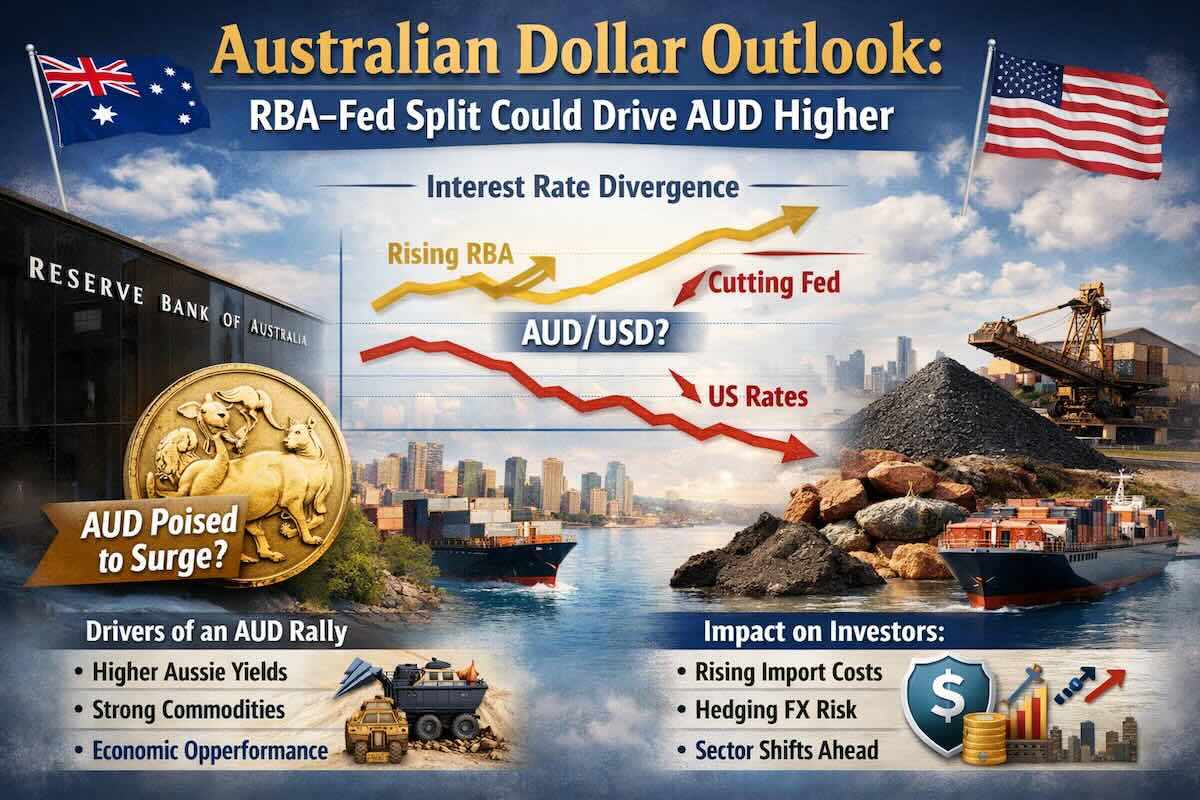
The tables are turning for the Australian dollar
Make no mistake: the outlook for interest rates in Australia and the United States is diverging rapidly — and that shift could soon start working in favour of the Australian dollar.
With US rates being cut again while the Reserve Bank of Australia has held steady, short-term policy rates in both countries are now effectively aligned at around 3.6%. That’s the first time they’ve matched since late 2024.
So far, the currency market has been slow to react. Many investors still believe US rates are near their low point, while Australian rates may yet fall further. But that assumption is increasingly under pressure.
Is the AUD Strong or Weak?
Analyzing the Australian dollar against a wide range of currencies offers a more complete view of its global strength. This approach captures broader trade relationships, emerging market trends, and diverse economic factors, providing a clearer picture of the dollar's performance in the world economy.
Why February could be the turning point
The next two months bring a heavy run of inflation and labour-market data in both economies. If current trends persist, money markets see a growing chance that US policy rates could fall below Australia’s as early as February.
That would be a significant moment. US rates have not been below Australia’s since 2000.
Markets are now moving away from the idea of further Australian rate cuts. Instead, expectations have swung toward rate rises over the next year, while the Federal Reserve is expected to continue easing. This reversal has already reshaped bond markets, pushing Australian yields sharply higher relative to the US.
Historically, such divergences have mattered. When Australia has moved into a clear interest-rate advantage over the US, the Australian dollar has often risen sharply — sometimes by double-digit percentages over relatively short periods.
⸻
What drives the Aussie when rates diverge
When forecasting the Australian dollar, markets look beyond just cash rates. Key drivers include:
• Interest rate differentials across the yield curve
• Global risk appetite
• Commodity prices and trade demand
• Relative economic growth and inflation
All else being equal, a stronger yield advantage creates positive “carry” for the Aussie — making it more attractive to hold relative to the US dollar. If that advantage widens meaningfully, the path of least resistance for AUD/USD could be higher.
⸻
Economic consequences of a stronger AUD
A rising Australian dollar would have mixed effects across the economy:
Potential benefits
• Cheaper imports, easing “imported” inflation
• Improved margins for importers
• Some relief for consumers facing cost-of-living pressures
Potential headwinds
• Reduced competitiveness for exporters
• Lower Australian-dollar earnings for companies reporting in US dollars
• Slower growth if export demand softens
Ironically, a strong enough currency could eventually cool inflation to the point where further rate hikes become unnecessary — tempering the very forces that lifted the dollar in the first place.
⸻
Markets, shares, and the FX puzzle
Interest-rate markets have already repriced aggressively, with the gap between Australian and US bond yields widening to multi-year extremes. Yet the Australian dollar has not followed as decisively as in past cycles.
That raises a key question: is the currency lagging the rates market?
If history is a guide, the answer may be yes — at least initially. In prior cycles, the Aussie often moved later, but sharply, once the divergence became undeniable.
⸻
What it means for investors and businesses
For Australian investors, the implications are far-reaching:
• Currency risk matters again: Overseas equity returns may need active hedging if the Aussie strengthens.
• Sector impacts will diverge: Resource and materials stocks often benefit from late-cycle growth, while interest-sensitive and consumer sectors can lag.
• FX planning becomes critical: Importers, exporters, and offshore investors should reassess hedging strategies.
The brief era of falling interest rates in Australia now appears over. The real question is whether rates simply stay on hold — or begin rising just as the US continues to ease.
If that divergence persists, the Australian dollar could be setting up for its most interesting phase in years.
Disclaimer: Please note any provider recommendations, currency forecasts or any opinions of our authors should not be taken as a reference to buy or sell any financial product.