Stay updated with USD tagged currency news, market trends, and exchange rate insights to make informed financial decisions.
Explore our latest USD tagged content. From expert guides and forecasts to provider reviews and practical money tips, these posts help you stay informed and make smarter currency decisions.
All Content (172)
By Topic:
About Us (12)
Africa (1)
Banks (1)
Business (1)
Business Fx Specialists (10)
Crypto (1)
Expat (11)
Foreign Currency Accounts (11)
Foreign Transfers (30)
Fx Analysis (5)
Fx Risk (6)
Fx Specialists (22)
Large Amounts (11)
Locations (10)
Ofx (12)
Online Sellers (1)
Popular (3)
Property (2)
Pursuits (1)
Revolut (8)
Study Abroad (7)
Travel (1)
Travel Cards (9)
Travel Money (12)
Wise (13)
By Currency: AED (28) AFN (1) ALL (1) AMD (1) ANG (2) AOA (1) ARS (2) AUD (77) AWG (1) AZN (1) BAM (1) BBD (1) BDT (1) BHD (1) BIF (1) BMD (1) BND (1) BOB (1) BRL (6) BSD (1) BTC (1) BTN (1) BWP (1) BZD (1) CAD (49) CDF (1) CHF (33) CLP (4) CNY (22) COP (1) CUP (1) CVE (1) CZK (5) DJF (1) DKK (9) DOP (1) DZD (1) EGP (2) ETB (1) EUR (114) FJD (6) FKP (1) GBP (75) GEL (1) GHS (2) GIP (1) GMD (1) GNF (1) GTQ (1) GYD (1) HKD (22) HNL (1) HTG (1) HUF (5) IDR (8) ILS (6) INR (31) IQD (1) IRR (1) ISK (1) JMD (1) JOD (1) JPY (31) KES (2) KGS (1) KHR (1) KMF (1) KPW (1) KRW (4) KWD (1) KYD (1) KZT (1) LAK (2) LBP (1) LKR (2) LRD (1) LSL (1) LYD (1) MAD (2) MDL (1) MGA (1) MKD (1) MMK (2) MNT (1) MOP (1) MRO (1) MUR (1) MVR (1) MWK (1) MXN (13) MYR (23) MZN (1) NAD (1) NGN (6) NOK (8) NPR (2) NZD (39) OIL (1) OMR (4) PEN (1) PGK (1) PHP (13) PKR (12) PLN (8) PYG (1) QAR (7) RON (2) RSD (1) RUB (8) RWF (1) SAR (9) SBD (4) SCR (1) SDG (1) SEK (9) SGD (38) SHP (1) SLL (1) SOS (1) SRD (1) SYP (2) SZL (1) THB (16) TJS (1) TMT (1) TND (1) TOP (1) TRY (8) TTD (1) TWD (12) TZS (1) UAH (2) UGX (2) USD (112) UYU (1) UZS (1) VEF (1) VND (11) VUV (1) WST (6) XAF (9) XCD (10) XOF (11) XPF (7) YER (1) ZAR (11) ZWL (1)
The United States dollar is the official currency of the United States of America but also is the world’s dominant reserve currency, and it accounts for roughly 62% of global foreign exchange reserves, double that of the Euro and Yen. In fact, the US Dollar has been the world’s reserve currency for over 100 years.
Weekly currency market update—practical actions for SMBs, expats and travellers across AUD, CAD, GBP, NZD, SGD, USD, EUR and JPY
Markets are rapidly repricing Australian interest rates higher while the US moves toward cuts — a mix that has historically been powerful for the Aussie dollar.
U.S.-based and choosing between Wise and Revolut? Here’s a clear, current comparison of fees, exchange rates, card/ATM rules, and travel perks—plus who each suits best.
Central banks are moving in different directions—Australia cuts, UK eases despite inflation, and the Fed faces political risks. Here’s what it means for exchange rates and transfer timing.
President Trump has raised U.S. tariffs to an average of 15.2%, targeting Canada, Asia, and Europe, as part of his push to reshape global trade. Markets and currencies reacted with caution amid rising uncertainty.
USD/MXN slipped below 19.00 as Mexico received a 90‑day reprieve from planned U.S. tariffs. The peso gained short‑term support, but traders now watch Fed policy and U.S. jobs data for the next market move.
Global FX markets shifted in July as the USD gained on trade deals, the British pound climbed, and the Indian rupee weakened on tariff fears. Here’s what’s driving currencies now.
The Swedish Krona's recent appreciation has led to a decline in public support for adopting the Euro, with only 32% favoring the change in 2025.
The euro's unexpected rise against the U.S. dollar presents the European Central Bank with a complex dilemma, as global trade tensions and policy shifts influence currency dynamics.
The US dollar surged following a 90-day tariff pause between the US and China, while the euro and yen weakened in response.
The Australian dollar has experienced notable fluctuations in 2025, influenced by global trade tensions and domestic political developments, including the Labor Party's decisive election win. However, trade tariffs imposed by the United States, have introduced volatility, prompting market analysts to adjust their forecasts for the currency's trajectory.
The Canadian dollar has defied political chaos and global headwinds to emerge as one of 2025’s unlikely winners. But with minority rule in Ottawa, soaring household debt, and a high-stakes U.S. election looming, the loonie’s fight for survival is just beginning.
Milei publicly criticizes economists as econo-swindlers and alarmists as Argentina's peso has defied expectations by maintaining stability following recent economic reforms, easing inflation concerns and bolstering investor confidence.
Deutsche Bank forecasts a significant weakening of the US dollar in the coming years, potentially reaching its lowest level against the euro in over a decade.
The US dollar has fallen to a three-year low, influenced by Trump policy back flips plus concerns over the Federal Reserve's independence. Analysts suggest a long-overdue correction due to overvaluation and trade tensions.
The Swiss franc has experienced a significant surge, reaching a decade-high against the U.S. dollar, following President Donald Trump's announcement of increased tariffs on Chinese imports. This development has intensified market volatility and heightened demand for safe-haven assets.
The Chinese yuan has weakened following the United States' decision to impose a 125% tariff on Chinese imports, prompting the People's Bank of China to intervene to stabilize the currency.
The Mexican peso's outlook for 2025 is clouded by potential U.S. tariffs and economic policies, with forecasts indicating possible depreciation against the U.S. dollar.
Discover how movements in the U.S. dollar affect everyday Americans — from the cost of imports and vacations to global competitiveness for exporters and manufacturers.
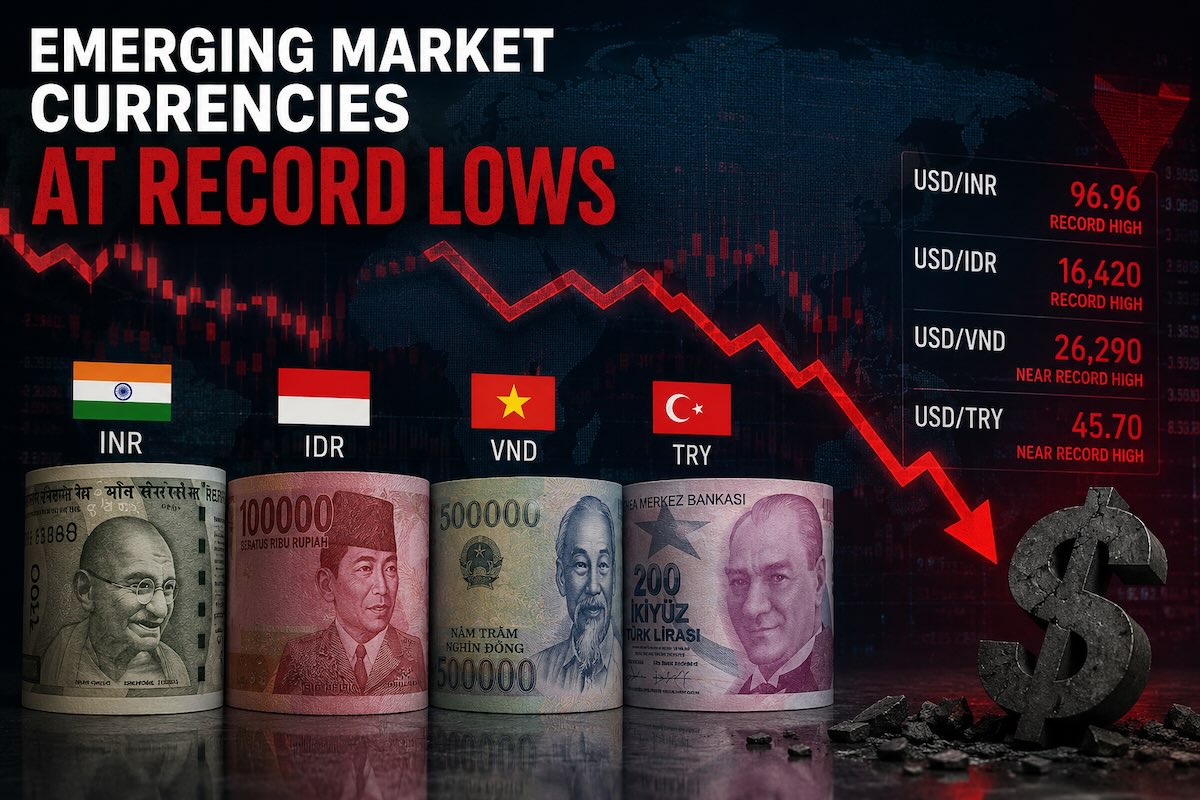
Recent U.S. trade policies, including aggressive tariffs on auto imports, have introduced significant volatility in global currency markets, affecting major currencies such as the euro, British pound, and Japanese yen.
The Indonesian rupiah approaches a historic low against the U.S. dollar, influenced by fiscal worries and government spending plans.
Markets have shifted focus to the interest rate policies of other major central banks rather than the Federal Reserve.
Economists are predicting that the Canadian dollar could rise this year.
The Singapore dollar has reached its highest level in over a decade, boosting outbound travel and curbing inflation, but also putting pressure on exporters and local businesses. While sectors like logistics and finance benefit, retail, hospitality, and exports face challenges from the strong currency.
The dollar has risen by nearly 20% against most currencies compared to this time last year.
Stronger AUD, USD, and GBP Against the Euro due to surprise French elections.
USD sinks as global currency markets react to slowing US inflation, prompting a surge in other major currencies and a potential end to the Federal Reserve's tightening cycle.
Central Bank Chief's Removal Sets Stage for Currency Liberalization
The US dollar weakened due to fears surrounding regional banks, while the ECB offered a less hawkish than expected 25bp hike and the Swiss franc is in demand.
As we approach mid-year a shift has taken place in currency markets with the narrative less about interest rates hikes and more risk-off worries about a possible coming recession.
During periods of rising inflation a stronger currency benefits a country's economics as this makes imports cheaper.
Recognising the impact of Covid-19 on its financial status, Hong Kong has reverted back to more lenient travel restrictions to improve life for both residents and travelers.
Global travel starts to revive so Thailand moves to revive its Economy after the pandemic.
'Fortress New Zealand' opening after two long pandemic years - Aussies welcomed back first on April 12th and other nationalities on 1st of May.
The operator of the world’s largest financial messaging system, SWIFT, has said it will trial real-time "gpi" cross-border payments using the European Central Bank's TIPS platform. SWIFT gpi has been developed as an answer to distributed ledger payment technologies, most notably Ripple.
The Democratic Republic of Timor-Leste, also known as East Timor, gained independence from Indonesia on 20 May 2002, making it the first new sovereign state of the 21st century. Despite its rich natural beauty and unique cultural heritage, includi...
Ecuador is a country located in South America, bordered by Colombia to the north, Peru to the east and south, and the Pacific Ocean to the west. It is known for its diverse culture and natural beauty. The country's official language is Spanish and...
El Salvador suffers horribly from bad press. While gang violence still dominates international headlines – and keeps so many adventurous travelers at bay – the vast majority of this beautiful country remains untouched by 'the troubles.'
...
The Turks and Caicos are a chain of 40 islands that include Providenciales (the most populated island) as well as Grand Turk, Middle Caicos, South Caicos, and more. There are two airports—on Providenciales and Grand Turk—but most travelers fly...
By staying informed and planning ahead, you can effectively manage your finances while enjoying your visit to the United States.
More than 60 islands –some of them uninhabited and declared national parks– make up this Caribbean archipelago, a paradise of lush rainforests, white-sand beaches and bright turquoise waters. Most visitors travel to the British Virgin Islands ...
This trio of islands in the Caribbean Sea—St. John, St. Croix, and St. Thomas—is famous for its dreamy beaches, world-class snorkeling and diving, and pristine beaches. Travelers can find accommodations for all types of trips, whether it's a f...
Bias: bullish-to-range-bound, current price sits above the 90-day average and in the upper half of the 3-month range.
Bias: bearish-to-range-bound, as USD/ZAR sits below its 90-day average and in the lower half of the three-month range.
Bias: bearish-to-range-bound, the current USD/XPF sits below its 90-day average and in the lower half of the three-month range.
Bias: Bearish-to-range-bound, with USDXOF below its 90-day average and in the lower half of the 3-month range.
Bias: bearish-to-range-bound, as USD is below the 90-day average and sits in the lower half of the recent 3-month range.
Bias: bearish-to-range-bound because USD/WST sits below its 90-day average and in the lower half of the 3-month range.
Bias: Bearish-to-range-bound, as USD/VND trades below its 90-day average and sits in the lower half of the three-month range, around 26,264 per USD, with...
Bias: bullish-to-range-bound, current above the 90-day average and in the upper half of the three-month range.
Bias: USD/TWD is bullish-to-range-bound, sitting above its 90-day average and in the upper half of the three-month range.
Bias: USD/TRY is bullish-to-range-bound, sitting above the 90-day average and in the upper half of the three-month range.
Bias: bearish-to-range-bound, with USD/SGD below the 90-day average and in the lower half of the three-month range.
Bias: bearish-to-range-bound, current USD/SEK is below the 90-day average and sits in the lower half of the 3-month range.
Bias: Bearish-to-range-bound: USD is below its 90-day average and sits in the lower half of the 3-month USD/SBD range.
Bias: bearish-to-range-bound, current USD/RUB trades below its 90-day average and sits in the lower half of the 3-month range, signaling limited upside without a new driver.
Bias: Range-bound, with USD/QAR near the 90-day average and in the middle of the 3-month range.
Bias: Bearish-to-range-bound, the USD/PLN sits below its 90-day average and in the lower half of the three-month range, reflecting modest PLN resilience...
Bias: bearish-to-range-bound, with USD/PKR trading below its 90-day average and in the lower half of the 3-month range, and near 14-day highs, within a narrow daily range.
Bias: USD/PHP is bullish-to-range-bound, above the 90-day average and in the upper half of the three-month range.
Bias: Bearish-to-range-bound, with USD/NZD trading below its 90-day average and in the lower half of the three-month range, implying limited downside but...
Bias: Bearish-to-range-bound, USD/NOK sits below the 90-day average and in the lower half of the three-month range.
Bias: Bearish-to-range-bound, with USD/NGN trading below the 90-day average and in the lower half of the 3-month range.
Bias: Bearish-to-range-bound, as USD/MYR sits below the 90-day average and in the lower half of the three-month range.
Bias: Bearish-to-range-bound: USD/MXN sits below the 90-day average and in the lower half of the 3-month range, leaving little room for a sustained break higher.
Bias: The USD/LKR is above the 90-day average and sits in the upper half of the last three months' range, producing a clear bullish-to-range-bound bias that...
Bias: bullish-to-range-bound, USD/KRW sits above the 90-day average and in the upper half of the three-month range, supported by a firmer US growth backdrop...
Bias: bullish-to-range-bound, as USD/JPY sits above its 90-day average and in the upper half of the three-month range.
Bias: bullish-to-range-bound, as USD/INR sits above its 90-day average and in the upper half of the last three months’ range.
Bias: Bearish-to-range-bound, as USD/ILS trades below the 90-day average and sits in the lower half of the 3-month range, with only modest upside potential.
Bias: USD/IDR is bullish-to-range-bound, trading above its 90-day average and in the upper half of the three-month range.
Bias: Range-bound, as USD/HUF sits near the 90-day average, in the middle of the 3-month range, and near 30-day highs.
Bias: bullish-to-range-bound, as the pair sits above its 90-day average and in the upper half of the three-month range.
Bias: bearish-to-range-bound, the pair sits below its 90-day average and in the lower half of the 3-month range, suggesting limited upside near term.
Bias: Range-bound, with USD/FJD near the 90-day average and in the middle of the 3-month range.
Bias: Bearish-to-range-bound, as USD/EUR sits below the 90-day average and in the lower half of the three-month range.
Bias: Bearish-to-range-bound: USD/EGP is below its 90-day average and sits in the lower half of the 3-month range, with risk tilted to limited downside unless flows turn.
Bias: range-bound, current sits near the 90-day average and in the middle of the 3-month range.
Bias: range-bound, with the current level near the 90-day average and in the lower half of the 3-month range.
Bias: bearish-to-range-bound, current USD/CNY sits below the 90-day average and at the lower end of the 3-month range.
Bias: bearish-to-range-bound, as USD/CLP sits below the 90-day average and in the lower half of the 3-month range.
Bias: Range-bound, current is near the 90-day average and sits in the lower half of the 3-month range.
Bias: Bearish-to-range-bound, USD/CAD sits below the 90-day average and in the lower half of its three-month range, suggesting limited upside unless new data shift the outlook.
Bias: Bearish-to-range-bound, as USD/BRL sits below its 90-day average and stays in the lower half of the 3-month range, signaling limited upside.
Bias: bearish-to-range-bound; the pair sits below its 90-day average and in the lower half of the 3-month range.
Bias: bearish-to-range-bound, as BTC sits below its 90-day average and in the lower half of the three-month range, implying a bias to drift lower but likely...
Bias: range-bound, current CADUSD sits near its 3-month average and lies in the lower half of the 3-month range.
Bias: bullish-to-range-bound, AUD sits above its 90-day average and in the upper half of the three-month range, signaling mild upside potential that is...
Bias: EUR/USD is range-bound, near the 90-day average and in the mid-range of its three-month range, with markets waiting for data.
The current market bias for the Mexican Peso (MXN) against the US Dollar (USD) is bearish, with expectations of a softer peso.
The MYR to USD exchange rate shows a neutral bias in the near term, with the MYR trading close to recent highs.
The market bias for PHP to USD is currently bearish, reflecting recent trends in the currency pair.
The NOK to USD exchange rate is currently bearish, experiencing pressures from both local and global economic factors.
The current market bias for the Qatari Riyal (QAR) against the US Dollar (USD) is range-bound.
The recent forecasts for the OIL to USD exchange rate show a complex interplay between US economic indicators and oil market dynamics.